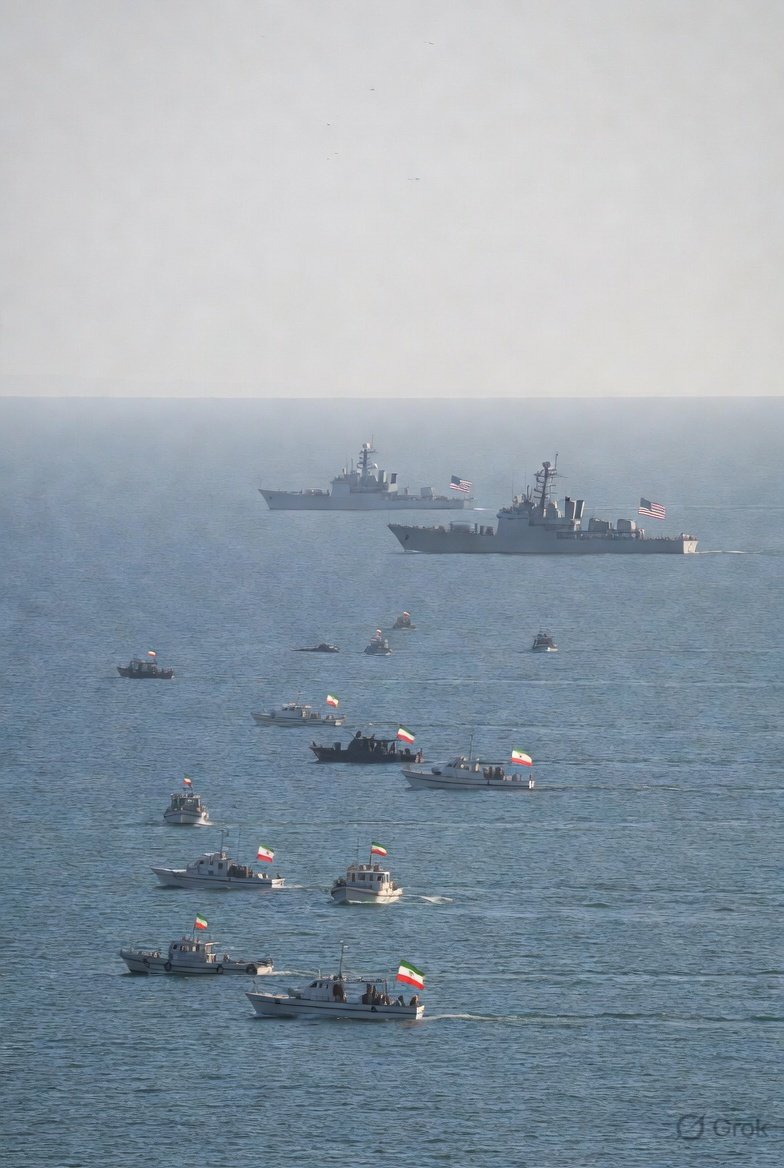
hve escalating Middle East conflict has thrust the Strait of Hormuz back into the global spotlight as a critical flashpoint. Recent statements from Iran’s Islamic Revolutionary Guard Corps (IRGC) highlight rising tensions over maritime traffic through this vital chokepoint, which handles roughly 20% of the world’s oil supply.IRGC’s Defiant Warning to the USAccording to reports from AFP and other sources, Iran’s Revolutionary Guards have declared they are “waiting” for US forces to attempt escorting ships through the Strait of Hormuz. IRGC spokesman Ali Mohammad Naini stated: “We are waiting for their presence,” in response to indications that the US Navy might deploy escorts to protect tanker traffic amid the ongoing regional war.The statement carries a clear threat, urging the US to “remember the fire of the American supertanker Bridgeton in 1987” — and referencing more recent attacks on oil tankers. This is a direct reference to the Bridgeton incident during the Tanker War phase of the Iran-Iraq conflict. In July 1987, under Operation Earnest Will (where the US reflagged and escorted Kuwaiti tankers), the supertanker SS Bridgeton struck an Iranian mine while under US Navy protection. The explosion caused significant hull damage but the ship remained afloat — a humiliating reminder for the US that even escorted convoys were vulnerable to Iranian naval tactics like mining.The IRGC’s message appears to dare the US to repeat such an operation, implying similar or worse consequences in the current environment.Current Situation in the StraitSince early March 2026, the IRGC has claimed “total” or “complete” control over the Strait of Hormuz, with senior officials warning that unauthorized vessels — especially from the US, Israel, Europe, or allies — risk being targeted by missiles, drones, or other means. Traffic has been severely disrupted: few boats are crossing, with long gaps in tracking signals for vessels attempting passage.The attached AFP map (from the post) illustrates this reality:
- It shows approximate routes of several recent vessels (e.g., PARISAN bulk carrier, PUSHPAK and BITUMEN tankers, DANUTA I gas tanker, HOUT cargo ship, and others like SHIB DERAZ, AYRYN).
- Dotted lines indicate tracking gaps, highlighting how signals disappear near the chokepoint.
- Key incidents are marked around March 3–6, 2026, with positions near Iran’s coast (Bandar Abbas, Qeshm Island area) and the narrow Strait between Iran and Oman/UAE.
This visual from AFP analysis (based on data from Copernicus/Sentinel-1, Kpler, MarineTraffic, and VesselFinder) underscores how maritime activity has been “strangled,” with only sporadic attempts at crossing amid the war.Broader ImplicationsThe Strait of Hormuz remains one of the world’s most strategic waterways. Any sustained disruption could spike global energy prices dramatically, affect supply chains, and draw in more international naval forces. The US has signaled readiness to provide escorts and even political risk insurance for tankers, but Iran’s warnings — backed by its arsenal of mines, fast boats, drones, and missiles — raise the stakes for direct confrontation.As the regional war rages, the Strait has become a test of deterrence, resolve, and the balance of power in the Persian Gulf. Whether US escorts materialize — and how Iran responds — could define the next phase of this crisis.Stay tuned for developments, as this situation evolves rapidly. Sources include AFP reporting, Reuters, Al Jazeera, and historical context from the 1987 Bridgeton mining.